



P/Q-type calcium channel
P/Q-type calcium channels (CaV2.1) are high-voltage-gated calcium channels that contribute to vesicle release at synaptic terminals and primarily support synaptic transmission at fast synapses[1][2]. Mechanistically, depolarization activates presynaptic Ca2+ channels, Ca2+ entry triggers neurotransmitter release, and CaV2.1 forms active-zone signaling complexes that regulate synaptic strength and presynaptic plasticity[3]. In disease-relevant models, CaV2.1 dysfunction or mutation links this channel to ataxia, migraine, Alzheimer’s disease, episodic ataxia type 2, familial hemiplegic migraine type 1, and spinocerebellar ataxia type 6[1][4]. Compared with related isoforms, CaV2 channels initiate fast synaptic transmission, whereas CaV1 channels support contraction, secretion, gene-expression regulation, synaptic-input integration, and ribbon-synapse transmission, and CaV3 channels support repetitive firing in rhythmically firing cells[2]. Experimental studies also distinguish P/Q-type channels from N-type channels because P/Q-preferring presynaptic slots can accept N-type channels, whereas overexpressed P/Q-type channels do not reciprocally replace N-type channels[5]. For experimental applications, ω-agatoxins remain the only specific P/Q-type blockers, while other peptide blockers and low-molecular-weight compounds show lower selectivity or complex modulation profiles[1][6].
References:
- [1]. Nimmrich V, et al. P/Q-type calcium channel modulators. Br J Pharmacol. 2012 Oct;167(4):741-59. [Content Brief]
- [2]. Catterall WA. Voltage-gated calcium channels. Cold Spring Harb Perspect Biol. 2011 Aug 1;3(8):a003947. doi: 10.1101/cshperspect.a003947. PMID: 21746798; PMCID: PMC3140680. et al. Voltage-gated calcium channels. Cold Spring Harb Perspect Biol. 2011 Aug 1;3(8):a003947. [Content Brief]
- [3]. Mochida S. Presynaptic Calcium Channels. Int J Mol Sci. 2019 May 6;20(9):2217. doi: 10.3390/ijms20092217. PMID: 31064106; PMCID: PMC6539076. et al. Presynaptic Calcium Channels. Int J Mol Sci. 2019 May 6;20(9):2217. [Content Brief]
- [4]. Uchitel OD, et al. CaV2.1 voltage activated calcium channels and synaptic transmission in familial hemiplegic migraine pathogenesis. J Physiol Paris. 2012 Jan;106(1-2):12-22. [Content Brief]
- [5]. Cao YQ, et al. Different relationship of N- and P/Q-type Ca2+ channels to channel-interacting slots in controlling neurotransmission at cultured hippocampal synapses. J Neurosci. 2010 Mar 31;30(13):4536-46. [Content Brief]
- [6]. Pringos E, et al. Peptide neurotoxins that affect voltage-gated calcium channels: a close-up on ω-agatoxins. Toxins (Basel). 2011 Jan;3(1):17-42. [Content Brief]
-
P/Q-type calcium channel Related Products (6)
Related Products (6)

-
ω-Agatoxin IVA TFA
 0 ImagesCat. No.: HY-P1080APurity: 99.52%ω-Agatoxin IVA TFA is a potent, selective P/Q type Ca2+ (Cav2.1) channel blocker with IC50 values of 2 nM and 90 nM. ω-Agatoxin IVA TFA inhibits glutamate exocytosis and calcium influx elicited by high potassium. ω-Agatoxin IVA TFA inhibits Capsaicin (HY-10448)-induced CGRP release and vasodilation. ω-Agatoxin IVA TFA can be used for the research of neurological and cardiovascular disease.
-
ω-Agatoxin IVA
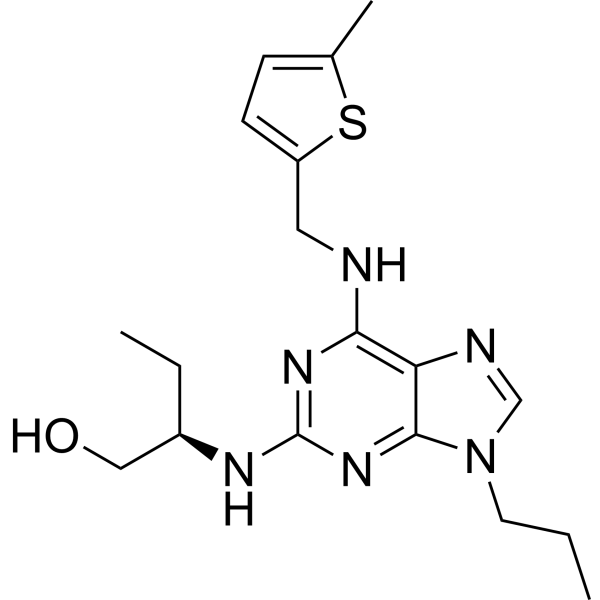
 0 Imagesω-Agatoxin IVA is a potent, selective P/Q type Ca2+ (Cav2.1) channel blocker with IC50 values of 2 nM and 90 nM. ω-Agatoxin IVA inhibits glutamate exocytosis and calcium influx elicited by high potassium. ω-Agatoxin IVA inhibits Capsaicin (HY-10448)-induced CGRP release and vasodilation. ω-Agatoxin IVA can be used for the research of neurological and cardiovascular disease.
-
ω-Agatoxin TK
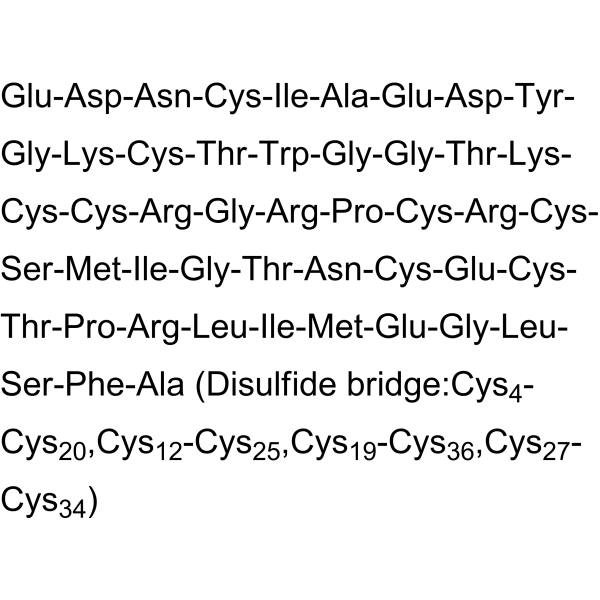 0 Imagesω-Agatoxin TK, a peptidyl toxin of the venom of Agelenopsis aperta, is a potent and selective P/Q type Ca2+ channel blocker. ω-Agatoxin TK inhibits the high K+ depolarisation-induced rise in internal Ca2+ in cerebral isolated nerve endings with an IC50 of of 60 nM. ω-Agatoxin TK has no effect on L-type, N-type, or T-type calcium channels.
-
sFTX-3.3
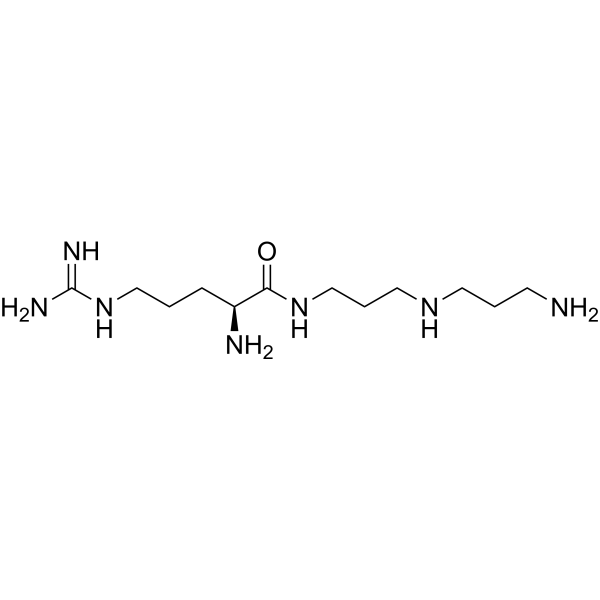 0 ImagesCat. No.: HY-131942CAS No.: 141997-14-0sFTX-3.3 is a Ca2+ channel antagonist with IC50s of approximately 0.24 mM and 0.70 mM against P-type and N-type channels.
-
LY393615
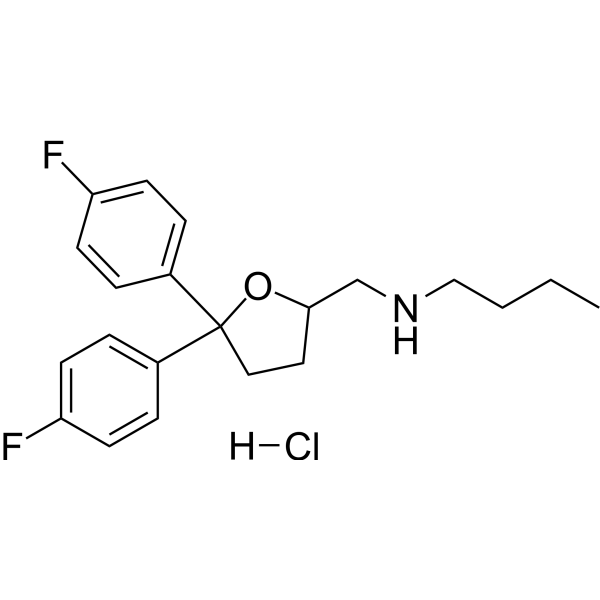 0 ImagesCat. No.: HY-135478CAS No.: 325819-97-4Synonyms: NCC1048LY393615 (NCC1048) is a novel neuronal Ca2+ (calcium channel) and Na + channel (sodium channel) blocker with IC50s of 1.9 μΜ and 5.2 μΜ for α1A and α1B calcium channel subunits. LY393615 has good brain penetration and neuroprotective effects in models of in cerebral ischemia that can be used for neurological disease research.



